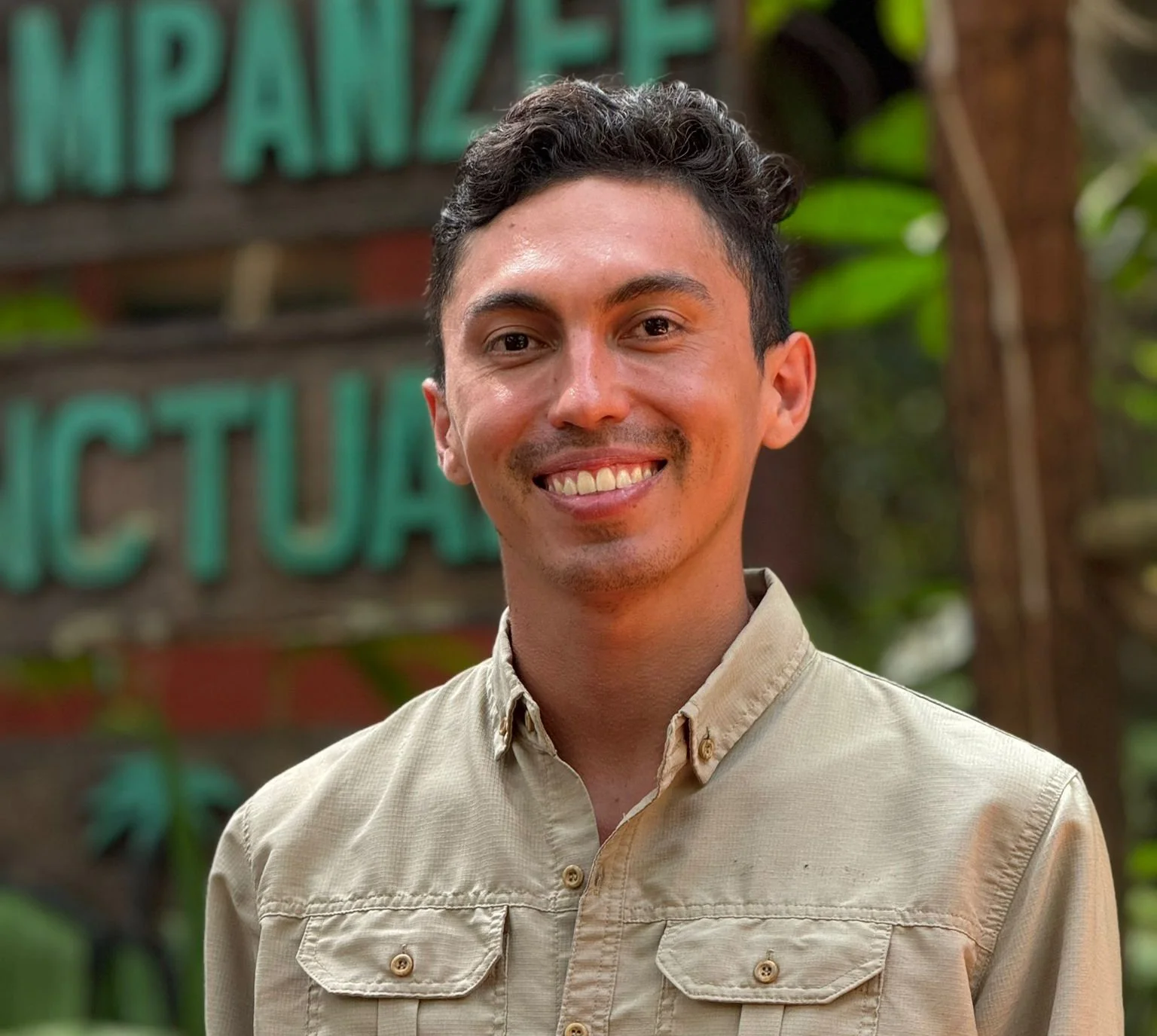
TFN Talks had the honour of sitting down with Jesús Romero, founder of Guaya Ecotours, a sustainable tourism operator in La Macarena, Colombia. Guaya have hosted and shown the beauty of Colombia’s natural treasures to thousands of visitors over the years, including HRH King Charles. We spoke about his passion for nature and conservation, his inspirational encounter with the late Jane Goodall and his courageous decision to start a new life in Canada.
“At Guaya, we believe that ecotourism is not just a business — it’s a way to protect ecosystems, preserve culture, and build peace. Every challenge is also an opportunity to innovate, lead by example, and show that a different kind of tourism — one rooted in care, respect, and sustainability — is not only possible, but necessary.”
Jesus, tell us where you are from and how has your heritage inspired your current life path?
I'm from La Macarena, Colombia — a place where the jungle breathes life into everything. Originally known as El Refugio, this small town was founded as a safe haven during the civil war between Conservatives and Liberals in the 1950s. Today, it remains a living sanctuary — rich in culture, resilience, and breathtaking biodiversity. Nestled where the Amazon, Orinoco, and Andes ecosystems converge, La Macarena is home to Caño Cristales — the iconic "Rainbow River" — and the majestic Serranía de La Macarena mountain range. This region hosts some of the oldest geological formations on Earth and countless endemic species, and it carries the legacy of ancestral civilizations who left behind sacred rock carvings and rupestrian art dating back more than 12,000 years.
Growing up in the heart of this jungle, I was surrounded by powerful nature and deep-rooted wisdom. My identity as a Latino from this land shaped not only how I see the world, but how I choose to engage with it. I learned early on that harmony with nature is not just a value — it’s a way of life. It gave me a deep sense of purpose that continues to guide me today. This connection inspired me to study environmental engineering and dedicate my life to protecting ecosystems and promoting responsible tourism. But beyond a profession, it’s been a way to give back — to honor the resilience of my community and share with the world the beauty and dignity of a region that was once forgotten, misunderstood, or overshadowed by conflict.
Today, La Macarena is transforming through ecotourism — turning rivers, forests, and ancestral lands once hidden by war into symbols of peace, healing, and sustainability. Our story is one of hope: showing how communities can rise, protect their heritage, and build a future rooted in inclusion and respect for life. I carry this story with me everywhere I go. It is my heritage, my mission, and the reason I continue to work toward a more compassionate, conscious, and connected world.
What exactly does an environmental engineer do?
Environmental engineering is a multidisciplinary field that applies principles of science, technology, and engineering to develop innovative solutions that protect the environment and enhance public health. Environmental engineers address critical challenges such as water and air pollution control, waste management, soil and groundwater remediation, climate change mitigation, and the sustainable use of natural resources.
Professionals in this field may work in areas like designing and optimizing water treatment and distribution systems, developing air quality management strategies, implementing hazardous waste treatment, integrating renewable energy solutions, and conducting environmental impact assessments to ensure responsible development. Beyond technical design, environmental engineers often operate at the intersection of policy, science, and community engagement to promote sustainability and compliance with environmental regulations.
In my case, I’ve transitioned from traditional engineering roles into conservation and sustainable tourism — a sector where I continue to apply my engineering knowledge. I integrate sustainable infrastructure design, promote the use of renewable energy, and implement low-impact tourism practices to protect fragile ecosystems. This approach allows tourism not only to minimize its ecological footprint, but to become a tool for community empowerment and environmental preservation.
To me, environmental engineering is more than a profession — it's a commitment to harmonizing human activities with the natural world. It's about using scientific knowledge and innovative technologies to build a more sustainable and equitable future for both people and the planet.
You are the founder of an amazing eco-tourism company back home in beautiful Colombia. Can you tell us how you came up with the idea for GUAYA and what does the name mean?
The idea for Guaya was born from a deep love for my homeland—La Macarena, Colombia. For decades, this breathtaking region remained largely unknown to the world due to the impact of armed conflict. But with the signing of the peace agreements, a new chapter began. These once-inaccessible landscapes became safe to explore, offering a powerful opportunity to protect nature while creating new pathways for sustainable local development.
At the same time, social media began to spotlight the beauty of places like Caño Cristales, attracting curious and conscious travelers seeking authentic, transformative experiences. I saw this as a unique chance to create something meaningful: a tourism model rooted in conservation, inclusion, and community empowerment.
That vision became Guaya—a company founded on the belief that tourism can be a tool for positive change. Our goal is to protect ecosystems, honor local cultures, and generate dignified livelihoods for the people who live in and care for these lands.
The name “Guaya” carries deep meaning. It honors the Guayabero River and the Guayabero and Tinigua Indigenous peoples, who are ancestral guardians of the region. It also echoes “Gaia,” the ancient concept of Mother Earth, symbolizing our deep respect for nature and our responsibility to protect it.
Guaya is the result of a collective effort. It has been shaped by the strength, wisdom, and hospitality of La Macarena’s community—local guides, farmers, cooks, artisans, and families—who have embraced tourism as a path toward peace and sustainability. Their commitment is what gives life to every experience we offer.
We’ve also been fortunate to count on the support of key institutions. Their collaboration has been fundamental in promoting La Macarena as a destination of peace, biodiversity, and ecological awareness.
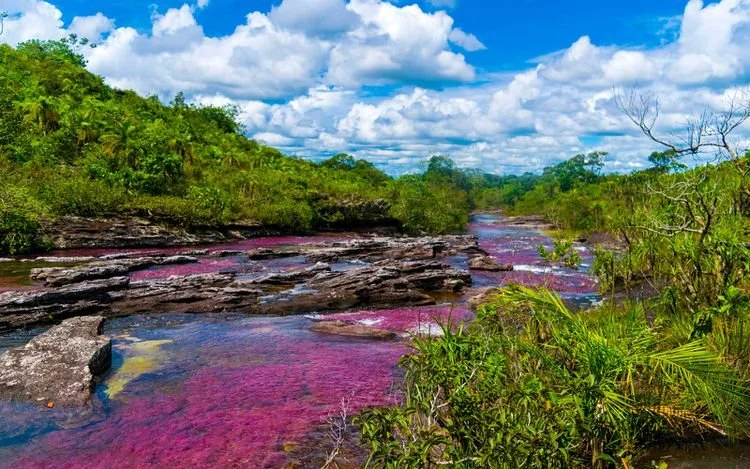
Credit: Jose Carlos Zapata Flores/Getty Images ‘Caño Cristales River’, La Macarena National Park
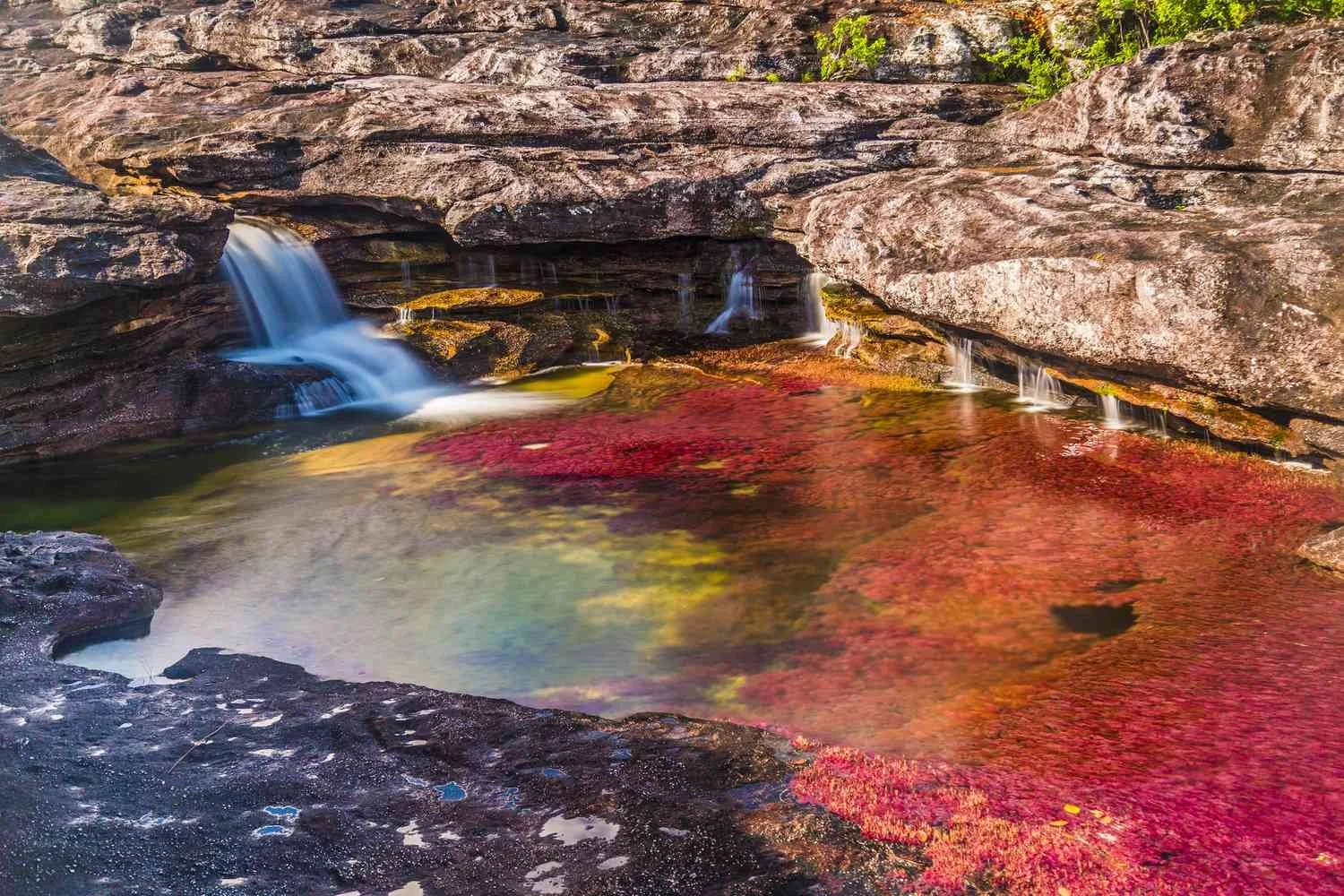
Credit: Jose Carlos Zapata Flores/Getty Images ‘Caño Cristales River’, La Macarena National Park
Guaya’s mission is to provide high-quality, sustainable tourism experiences that enrich both the travelers lives and the community. How do you go about doing this and what can tourists expect to take away from these experiences?
At Guaya, we believe tourism should be a powerful tool for positive change—one that protects fragile ecosystems, celebrates cultural heritage, and supports the well-being of local communities. Our approach is built on collaboration. We work directly with local guides, families, and entrepreneurs to ensure that the economic and social benefits of tourism are equitably shared. This model helps reinforce local pride, preserve traditions, and strengthen community resilience.
Our experiences are intentionally designed to be immersive, educational, and transformative. Travelers don’t just pass through; they engage. They hike through ancient ecosystems, learn about endemic species, hear stories of ancestral wisdom, and share moments with communities that have lived in balance with nature for generations.
We also emphasize environmental stewardship. We actively minimize our ecological footprint and support conservation efforts, particularly in biodiverse regions under threat from extractive industries. As part of this commitment, we promote a plant-based ethic rooted in compassion and sustainability. In regions like La Macarena, where cattle ranching has historically contributed to deforestation and biodiversity loss, vegan principles align with our mission to protect these critical ecosystems.
Ultimately, what travelers take away goes far beyond photos or souvenirs. They leave with a deeper understanding of the natural and cultural richness of Colombia, a heightened awareness of global conservation challenges, and the empowering sense that they’ve contributed to something meaningful—supporting peace, sustainability, and inclusive development in a region with a powerful story of transformation.
What challenges do you run into, operating a business that prides itself on sustainability and leaving the smallest ecological footprint possible?
One of the most persistent challenges is operating in a world where terms like sustainability, climate change, and global warming are part of everyday conversations — yet often treated with apathy or superficial concern. There’s still a widespread lack of real responsibility and empathy from both public and private sectors, as if environmental issues were distant problems that don’t require urgent action.
But this disconnect isn’t just external — we also face challenges within our own communities. After decades of social and economic struggles, many people are understandably focused on immediate survival. Convincing them that long-term sustainability and conservation can also bring prosperity isn’t always easy. There can be skepticism about ecotourism or resistance to changing traditional practices that harm ecosystems. That’s why education, trust-building, and creating visible benefits for the community are fundamental parts of our work.
Another major challenge is access to funding. Sustainable tourism projects often require significant investment upfront — from infrastructure that minimizes environmental impact to training programs for local guides and conservation efforts. Unfortunately, there’s still a gap when it comes to public and private investment in grassroots, nature-based solutions. Support for sustainable entrepreneurship is limited, especially in rural areas, and navigating complex funding systems can be a huge barrier for small organizations like ours.
Despite all this, we remain deeply committed. At Guaya, we believe that ecotourism is not just a business — it’s a way to protect ecosystems, preserve culture, and build peace. Every challenge is also an opportunity to innovate, lead by example, and show that a different kind of tourism — one rooted in care, respect, and sustainability — is not only possible, but necessary.
What have been some of the most memorable moments for you whole building this company and where do you plan on taking it in the future?
That’s a deep question — it brings up so many memories, both inspiring and challenging, that have shaped this journey. Building Guaya has been about more than creating a company; it’s been a personal and collective mission rooted in purpose, identity, and resilience.
One moment that stands out happened right before I moved to Toronto. As a farewell, some close friends and I hiked to the top of the Serranía de La Macarena. There, surrounded by ancient rupestrian art carved into some of the oldest rock formations on Earth, I felt something powerful — a connection to our ancestors, to the land, and to the story I wanted to tell through Guaya. That experience helped me define our purpose: to honor nature and culture through sustainable, meaningful tourism.
Another milestone that fills me with pride was seeing my mom — who has always been my biggest supporter — represent La Macarena in a USAID program called Destino Naturaleza. Knowing that my work opened doors for my family to be part of these initiatives is incredibly fulfilling. It reminds me that this is not just a business but a movement that creates opportunities and empowers others.
I'm also proud to say that Guaya became the first small business (Pyme) from our region to join the Diverse Chamber of Commerce in Colombia. Opening our doors as an inclusive and safe space for everyone — regardless of gender identity, sexual orientation, background, or beliefs — is something we live. Inclusion and sustainability go hand in hand, and we’re committed to being a model of both.
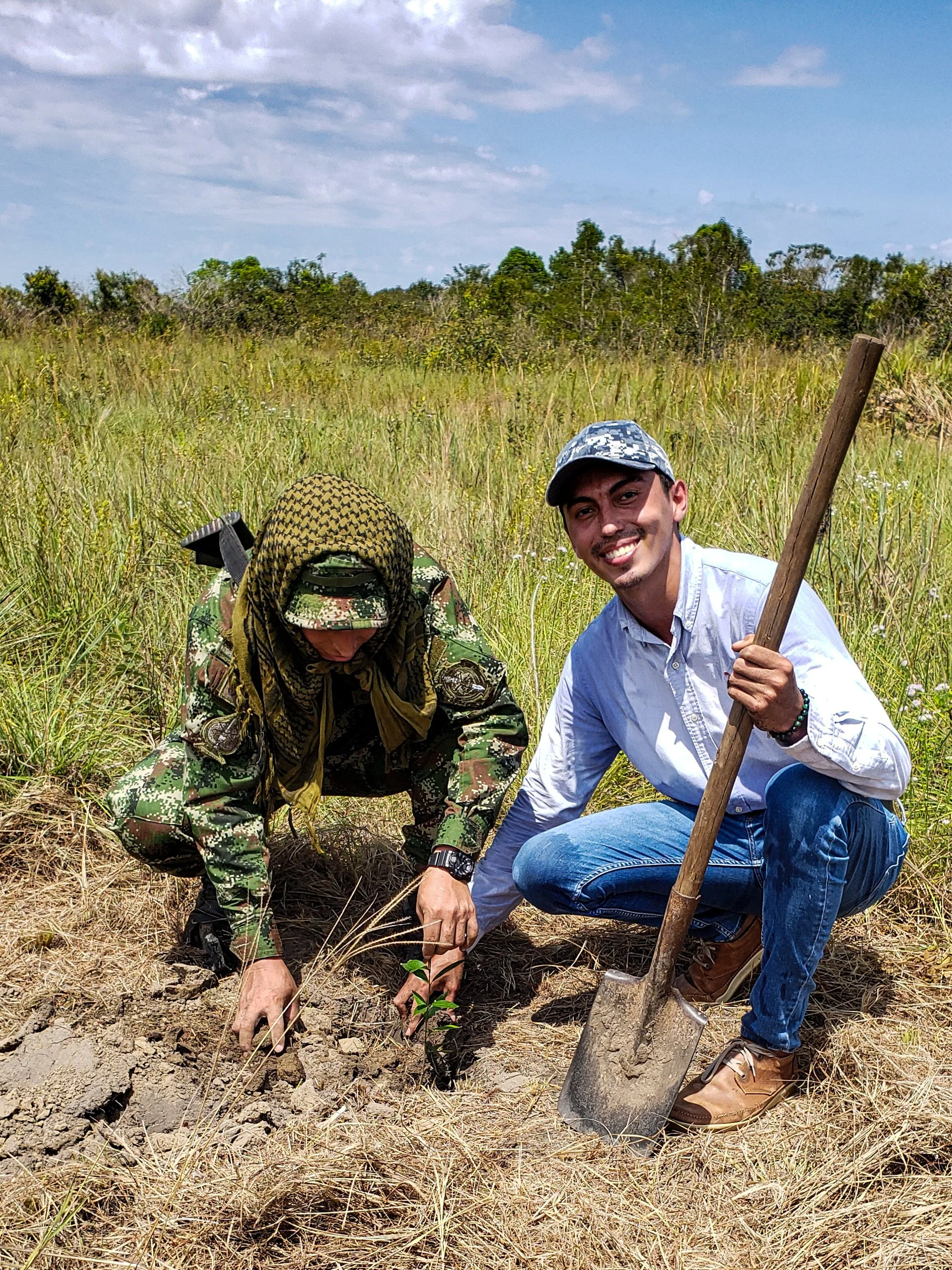
As for the future, I envision Guaya becoming more than an ecotourism company. I want it to grow into a platform for conservation, environmental education, and community empowerment — not only in Colombia, but also through global collaborations. I see us creating eco-lodges, supporting research and reforestation, mentoring youth, and continuing to prove that sustainable development is possible when it’s rooted in respect, knowledge, and collective action.
“I made the difficult decision to seek asylum in Canada — not only for my safety but to continue my mission in a country that values human rights, diversity, and sustainability. Canada has given me the opportunity to rebuild my life with dignity, to advocate for the planet without fear, and to use my voice in spaces where it can have a meaningful impact.”
We met in Toronto, can you tell us the story of how you ended up on this side of the globe?
Like many other immigrants who have made their way to this beautiful country, my journey to Canada has been one of both challenge and hope. It has been marked by uncertainty, transition, and difficult choices — but also by growth, resilience, and a deep sense of purpose.
I arrived in Canada seeking safety, stability, and the opportunity to live authentically. As a member of the LGBTQ+ community, coming from a region where visibility is not always embraced presented both personal and professional challenges. In addition to navigating social barriers, my work in environmental conservation often placed me at odds with powerful economic interests in areas affected by deforestation, land grabbing, and extractive industries. Speaking out and taking action in defense of ecosystems came with real risks — a harsh reality shared by many environmental defenders around the world.
Ultimately, I made the difficult decision to seek asylum in Canada — not only for my safety but to continue my mission in a country that values human rights, diversity, and sustainability. Canada has given me the opportunity to rebuild my life with dignity, to advocate for the planet without fear, and to use my voice in spaces where it can have a meaningful impact.
This chapter has been deeply transformative. While leaving home was not easy, it allowed me to strengthen my vision, connect with global communities, and reaffirm my commitment to building a more inclusive and environmentally conscious future. And although the journey is far from over, I continue to walk this path with gratitude, purpose, and the hope that each step forward brings me closer to the world I want to help create.
“My decision to adopt a vegan lifestyle was the result of deep reflection on the values I stand for — particularly my commitment to environmental conservation, animal welfare, and social responsibility.”
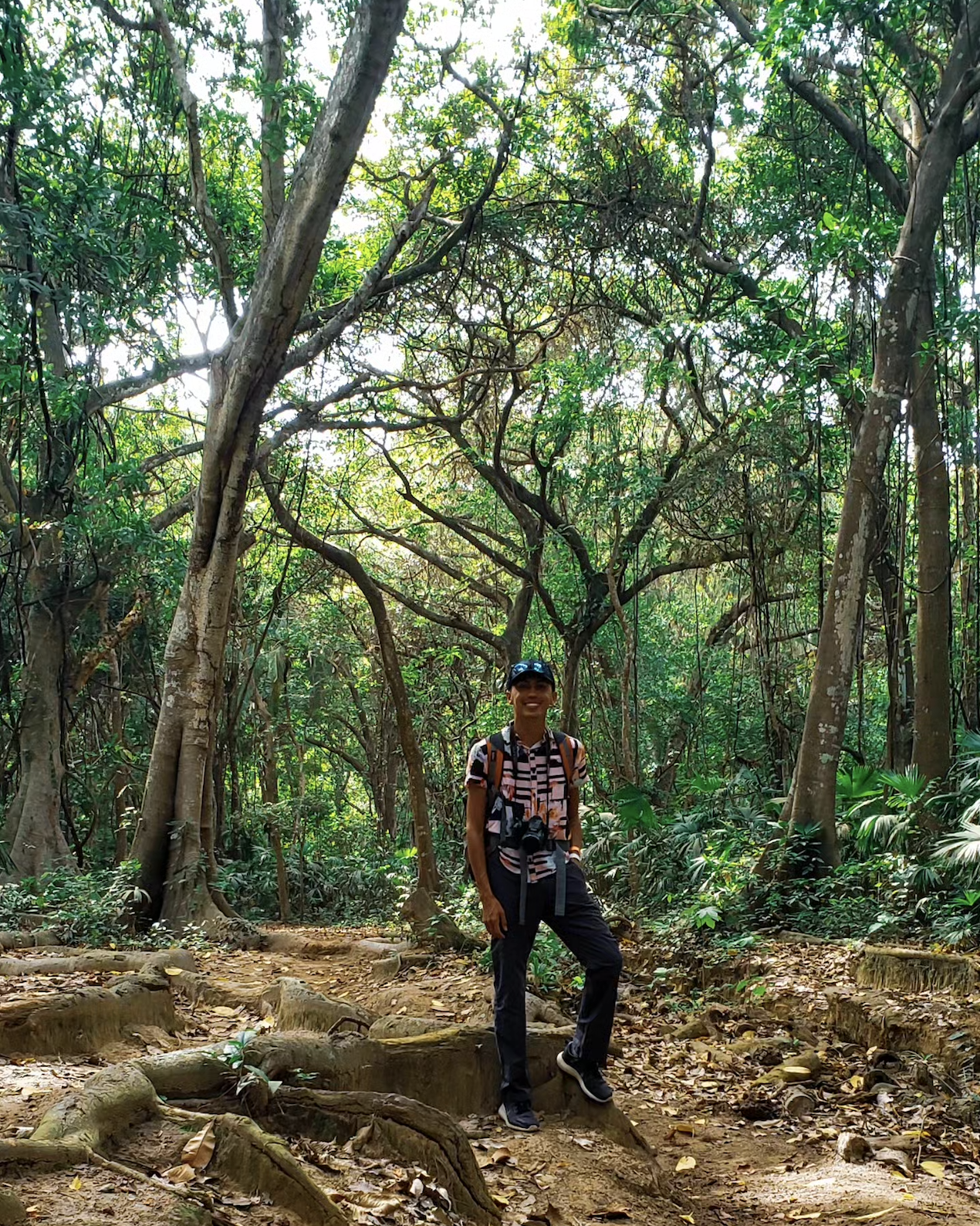
Can you tell us about what inspired you to go vegan and where that journey has taken you?
My decision to adopt a vegan lifestyle was the result of deep reflection on the values I stand for — particularly my commitment to environmental conservation, animal welfare, and social responsibility. As an environmental engineer working closely with ecosystems under threat, I realized that continuing to consume animal products contradicted the very mission I was advocating for. The environmental impact of industrial agriculture — especially deforestation, biodiversity loss, and greenhouse gas emissions — is undeniable. Choosing a plant-based lifestyle became an essential and coherent step in reducing my own ecological footprint.
But it wasn’t just about the environment. I was also profoundly moved by the ethical implications of how animals are treated — often reduced to mere commodities in a system that overlooks their capacity to suffer and their right to live freely. That realization was impossible to ignore.
Growing up in a region where natural habitats are being destroyed to make way for cattle ranching and agricultural expansion, I’ve seen firsthand how our consumption habits are directly linked to environmental degradation. This destruction doesn’t just threaten wildlife — it compromises the future of all species, including our own.
Veganism, for me, is more than a personal choice — it's a statement of accountability and a call to rethink our relationship with nature. It’s a commitment to future generations, to a more just food system, and to a more compassionate world. My partner, whose lifelong dedication to a sustainable and ethical way of living continues to inspire me, also played a key role in this transformation.
It’s important to understand that going vegan is not a switch you flip overnight — it’s a journey. A process of educating oneself, reflecting deeply, letting go of long-held habits and cultural traditions, and embracing new ways of thinking and living. It requires commitment, consistency, and a vision for a better tomorrow.
We need more people to see that small, conscious changes in our daily lives — like what we choose to eat — can have a massive impact. I believe that by aligning our values with our actions, we can help shift the course toward a more sustainable, just, and humane future for all beings.
As a fearless nomad, what are some of the most breathtaking places or adventures you have had over the years and why have they been memorable?
Throughout my journey, I’ve been fortunate to explore destinations that have left a lasting impression on both a personal and professional level — places where nature, culture, and purpose intersect in truly transformative ways.
In Colombia, I’ve been deeply inspired by regions like La Macarena and its surrounding landscapes, which embody not only extraordinary natural beauty but also the resilience and strength of communities embracing ecotourism as a path forward. Equally unforgettable is Tayrona National Park, where lush rainforest meets the Caribbean Sea. It’s a place rich in Indigenous heritage and biodiversity, reminding us of the critical importance of protecting sacred ecosystems.
Internationally, Peru’s Rainbow Mountain (Montaña de Siete Colores) offered an awe-inspiring experience — both physically demanding and spiritually elevating. Standing at high altitude and surrounded by surreal colors, you gain perspective on the raw power and fragility of the natural world.
In Mexico, I was captivated by the vibrant traditions, flavors, and hospitality of its people, particularly in San Miguel de Allende, one of the country’s renowned Pueblos Mágicos. Its colonial architecture, artistic spirit, and cultural richness make it a unique destination that beautifully blends history with modernity.
One of the most impactful experiences abroad was visiting the Tacugama Chimpanzee Sanctuary in Sierra Leone. This project goes far beyond wildlife rescue — it serves as a model of how ecotourism can drive conservation while fostering community development and education. It reaffirmed my belief in tourism as a powerful tool for systemic change when guided by strong values.
And of course, Costa Rica stands out as a global leader in sustainable tourism. Its commitment to environmental protection — including the bold decision to abolish its army to invest in education and conservation — is both inspiring and instructive. Experiencing the country’s “pura vida” ethos firsthand confirmed how deeply well-being and nature can coexist when sustainability is prioritized at every level.
Each of these places has shaped my vision as an environmentalist and entrepreneur. They’ve reminded me that travel, when done consciously, is not just about seeing the world — it’s about understanding it, respecting it, and using our experiences to inspire meaningful change.
Why should people visit Colombia and what are the top three places you recommend for us to go?
Colombia is one of the most biodiverse and culturally rich countries in the world. With six distinct natural and cultural regions — the Caribbean, Pacific, Andean, Amazon, Orinoquía, and Insular — and 32 departments, each offering its own unique traditions, landscapes, and local flavors, Colombia presents an unparalleled range of experiences for every kind of traveler.
From the vibrant energy of cities like Bogotá, Medellín, and Cali, to the serene beauty of remote rivers, national parks, and colorful heritage towns, Colombia invites visitors to explore deeply and meaningfully. What makes the country truly special is the warmth, resilience, and hospitality of its people — communities that, despite a complex past, are actively shaping a more inclusive, peaceful, and sustainable future.
Visiting Colombia is not just about discovering breathtaking nature or enjoying world-renowned coffee. It’s about connecting with a country that’s writing a new narrative — one where tourism is a powerful tool for conservation, economic empowerment, and cultural preservation.
We especially welcome travelers who are conscious and respectful of our journey — people who value sustainability, understand the importance of local context, and are eager to contribute positively to the places they visit. Colombia doesn’t just offer beauty; it offers a chance to be part of something meaningful.
Among the many unforgettable destinations, I highly recommend exploring Bahía Málaga, on Colombia’s Pacific coast — a paradise of mangroves and humpback whale migrations. La Guajira, in the far north, offers stunning desert landscapes and a deep cultural encounter with the Indigenous Wayuu people. And of course, La Macarena, home to Caño Cristales and the Serranía de la Macarena, where biodiversity, ancestral heritage, and ecotourism converge in one of the most unique ecosystems on the planet.
Whether you're drawn to adventure, wellness, biodiversity, or heritage, Colombia will leave you inspired, transformed, and eager to return.
What has been your proudest achievement in your career so far and why?
One of the most meaningful milestones in my career was the opportunity to meet Dr. Jane Goodall during her visit to Kitchener, Canada. As someone who has dedicated her life to conservation and the protection of our planet, her presence alone was deeply inspiring. During a brief encounter, she signed a copy of her book with the message: “Jesús, together we can make this a better world.” That simple yet powerful sentence left a profound mark on me. It served as a personal affirmation that the path I’ve chosen—working for environmental protection, sustainable development, and social justice—is not only necessary but part of a collective movement for a better future.
In a world often driven by short-term gains and disconnection from nature, those words reminded me that hope and action are inseparable. It reaffirmed my belief that through ecotourism, community engagement, and environmental education, we can create meaningful change—not just locally, but globally. That moment continues to fuel my commitment to be part of the solution.
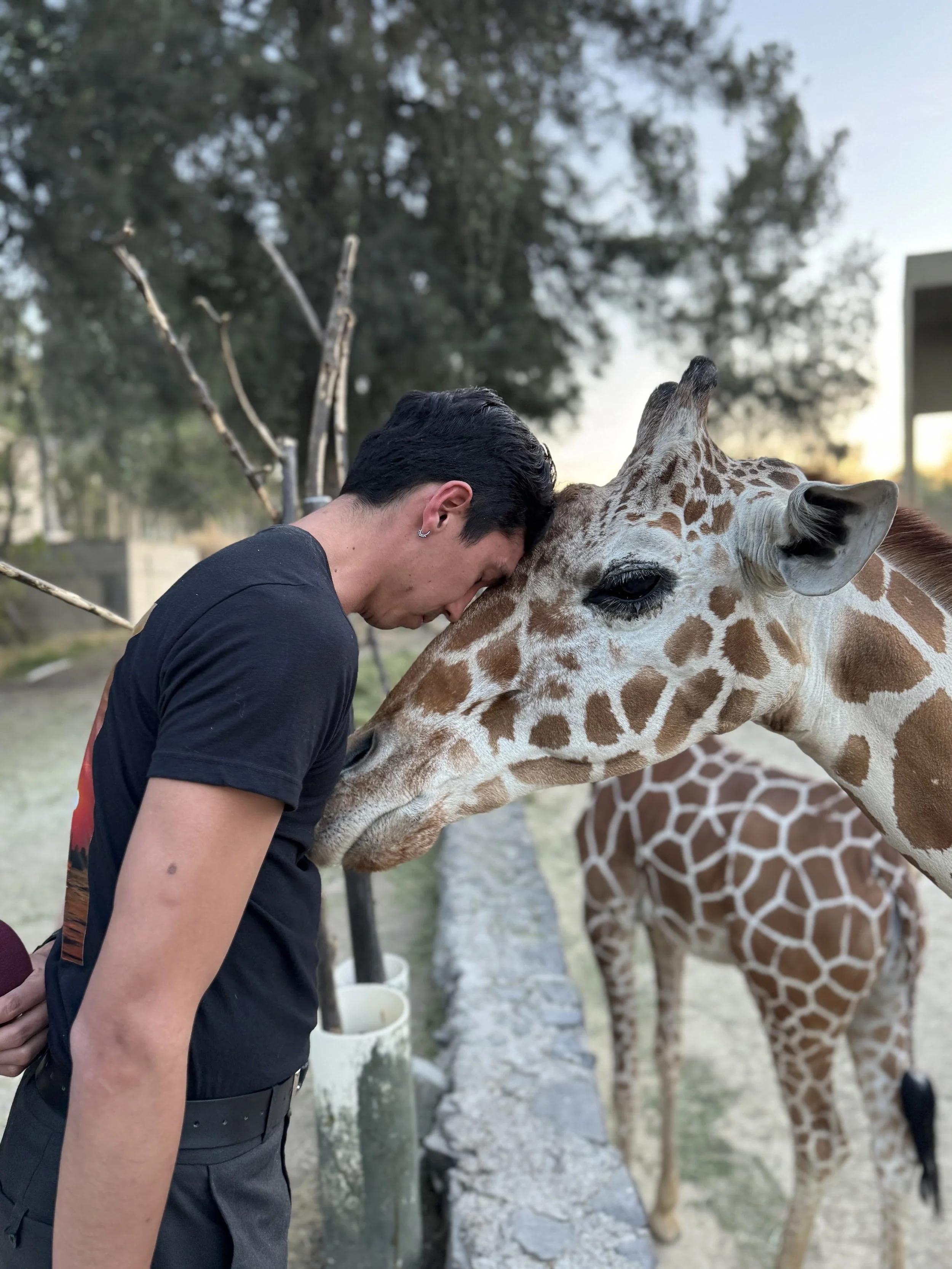
Jesus sharing a tender moment with a giraffe.
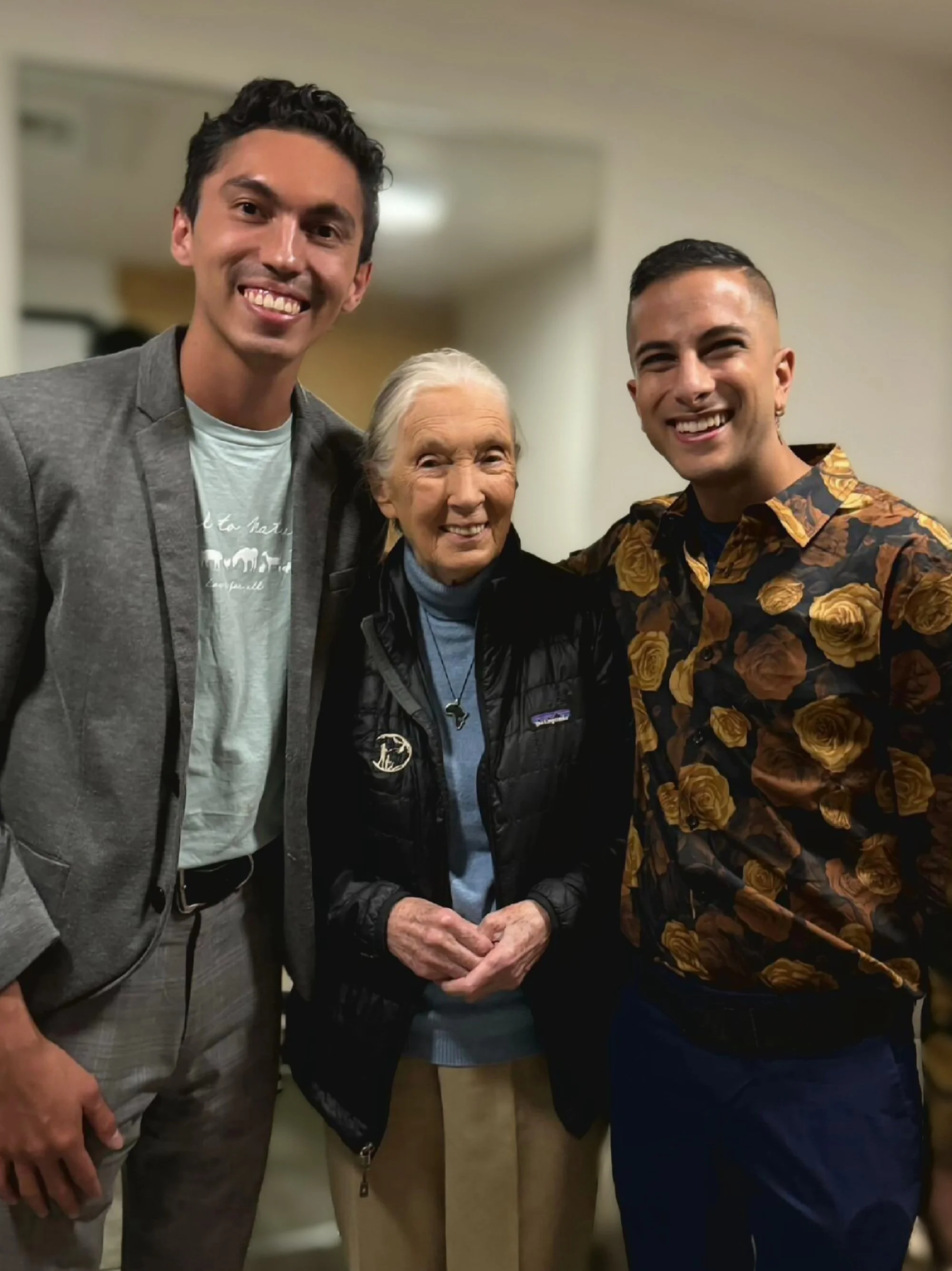
Jesus Romero with his partner, international wildlife veterinarian Ismail Hirji and the late legendary primatologist and anthropologist Jane Goodall.
Where should we expect to see you in ten years’ time?
In ten years, I see myself continuing to walk a path of purpose—working closely with local and global communities as a leader in sustainable development, environmental conservation, and social transformation. I hope that by then, the foundational phases of our long-term projects—particularly our conservation reserve, ecotourism infrastructure, and educational initiatives—will be fully operational and positively impacting lives. These efforts are deeply personal, rooted not only in my profession but in my responsibility as a human being committed to healing our relationship with the Earth.
I also envision a life with greater balance—where I can devote more time to my family and loved ones, nurturing the connections that sustain me and fuel my passion. I hope to continue growing spiritually, aligned with my values and guided by my faith in God, who has carried me through every chapter of this journey. His presence reminds me that this path is not just about building a career—it’s about fulfilling a calling to serve and uplift others through love, integrity, and action.
I would also love to have explored more of my creative side, particularly through the arts—using visual storytelling, writing, and community expression as tools to inspire, educate, and celebrate the richness of life, culture, and nature.
Above all, I hope that in ten years we are living in a more stable, compassionate, and united world—one where justice, empathy, and sustainability are not only ideals, but daily practices. I dream of a future where the seeds we are planting today—through tourism, conservation, and education—grow into forests of hope, resilience, and transformation for generations to come.